
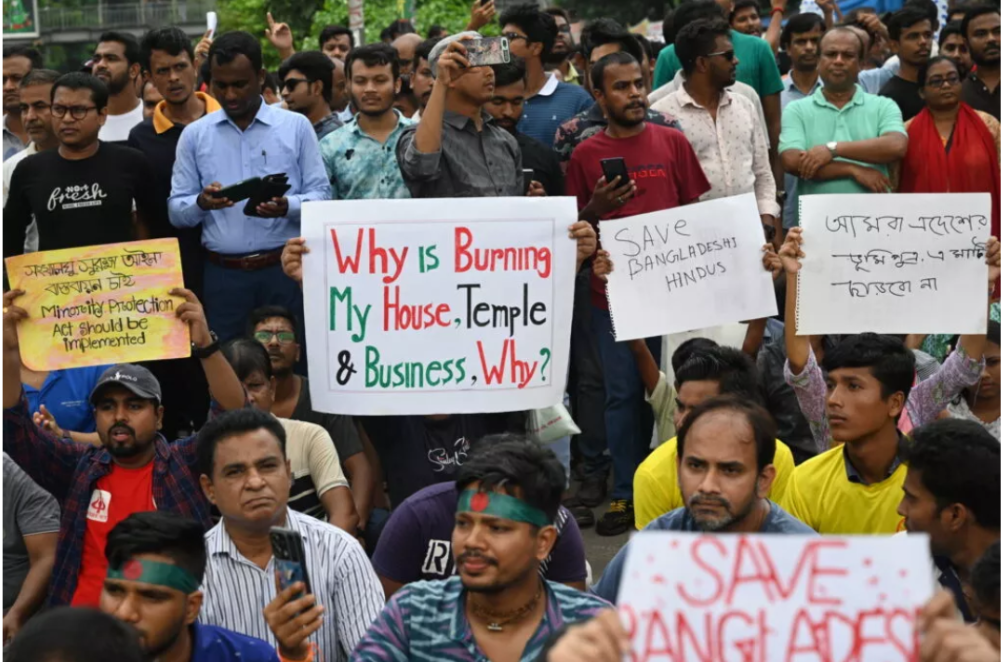
When 32-year-old factory worker Dipu Chandra Das stepped out of his home in Mymensingh on December 18, 2025, he had no reason to believe he would never return. Hours later, he was dead, lynched by a mob in an attack that stunned his community but surprised few who had watched Bangladesh’s political crisis deepen. Over the next 18 days, five more Hindu men across five districts were murdered in separate incidents, each killing adding to a growing sense of dread.
For Bangladesh’s Hindu minority, these deaths are not isolated crimes. They are the latest flashpoints in a long, painful history shaped by political turmoil, shifting alliances, and the fragile promise of minority protection. Understanding the present crisis requires an examination of the historical trajectory of displacement, the geopolitical realignment currently underway, and the lawful, non-violent pathways available to safeguard human rights ahead of the Bangladesh 2026 general elections.
A History Written in Partitions and Promises
The roots of today’s crisis stretch back more than a century. The first partition of Bengal in 1905 split the region along communal lines, igniting protests and sharpening identities. Its reversal in 1911 did little to ease tensions. By 1947, Bengal’s unity came to an irreversible end. The province was split along religious and political lines during the Partition of British India: West Bengal—with a Hindu‑majority population—became part of the new Republic of India, while East Bengal, home to a Muslim‑majority population, was incorporated into Pakistan as its eastern wing. This division reshaped the region’s cultural, political, and demographic landscape, setting the stage for the later emergence of Bangladesh in 1971. Pakistan received a very large amount of land in 1947 because the British and Indian leaders divided provinces, districts, and princely states under intense political pressure. In some ways, the rushed and chaotic nature of the process reminds us of how quickly the United States exited Afghanistan in 2021, leaving little time for orderly transition.
For Hindus who stayed behind, the new borders brought uncertainty. Under Pakistani rule, discrimination hardened into violence. The 1971 genocide, documented in the U.S. “Blood Telegram”, saw Hindus disproportionately targeted. The 1971 Blood Telegram was a famous and unprecedented diplomatic protest sent by the U.S. Consul General Archer K. Blood and his staff from the American Consulate in Dacca (now Dhaka, Bangladesh) on April 6, 1971. It is one of the strongest official dissents ever recorded in U.S. diplomatic history.
The telegram was a formal message sent to the U.S. State Department in which Mr Blood and 29 American diplomats condemned U.S. policy for remaining silent while the Pakistani military carried out mass atrocities in East Pakistan during the Bangladesh Liberation War.
The telegram stated that the U.S. government had:
– “failed to denounce the suppression of democracy”
– “failed to denounce atrocities”
– “failed to take forceful measures to protect its citizens”
It was a direct challenge to President Nixon, his advisor Kissinger administration’s support for Pakistan during the crisis. It is named after Archer Blood, the senior U.S. diplomat who authored and signed it. The name also symbolically reflects the bloodshed occurring in East Pakistan. After sending the dissent telegram, Mr Blood was removed from his post and sidelined in his career. This confirmed to him that the Nixon-Kissenger administration wanted silence, not truth for strategic reasons.
Kissinger’s strategy reflected the logic of Triangular Diplomacy. His central aim was to play China and the Soviet Union against each other—cultivating closer ties with Beijing to gain leverage over Moscow and strategically isolate the USSR. As part of this effort, Kissinger shared sensitive U.S. intelligence, including satellite data on Soviet military deployments, to signal goodwill and reassure China at a moment when it feared a potential Soviet attack. Within this broader geopolitical calculus, China ultimately chose to remain silent during the 1971 war.
Radical groups posed persistent threats, while government protection remained inconsistent. The demographic consequences were unmistakable: the Hindu population declined sharply—from 22% of East Pakistan’s population in 1951 to just 13.5% by 1974—reflecting decades of targeted violence, migration pressures, and systemic insecurity.
1971: Liberation, Sacrifice, and Unfinished Work
The Bangladesh Liberation War reshaped the Indian subcontinent. India’s intervention, triggered by Pakistan’s crackdown and a massive refugee influx, ended with the surrender of 93,000 Pakistani soldiers; the largest since World War II. India paid heavily: thousands of soldiers killed or wounded, and emergency taxes imposed to sustain the war effort.
Bangladesh emerged with a secular constitution. But the promise of protection for minorities would prove fragile.
Decades of Instability and a Shrinking Community
From 1971 to 2024, Bangladesh cycled through coups, political transitions, and rising extremism. Attacks on Hindu homes, temples, and businesses became a recurring feature of the country’s political landscape. By the 2022 census, Hindus made up just 7.95% of the population; another demographic warning sign.
2024: Hasina’s Fall and the Violent Unraveling
The resignation of Prime Minister Sheikh Hasina on August 5, 2024, amid student protests and allegations of repression, created a political vacuum. Nobel laureate Muhammad Yunus stepped in as head of an interim government, promising reforms and elections. Instead, violence surged.
Human-rights groups documented thousands of attacks on Hindu, Buddhist, Christian, Ahmadiyya, and indigenous communities. The six recent Hindu killings, from Mymensingh to Narsingdi, reflect a broader collapse of law and order. Analysts point to political retribution, land disputes, and emboldened extremist groups.
2026 Elections: A Nation on Edge
Bangladesh heads to the polls on February 12, 2026, in what may be its most consequential election in decades. With the Awami League sidelined, the BNP and radical groups have gained ground. Hindus, long perceived as Awami League supporters, have become strategic targets.
The December 2025 assassination of candidate Sharif Osman Hadi triggered retaliatory mob violence, including the lynching of Dipu Chandra Das. Subsequent killings of businessmen Khokon Chandra Das and Rana Pratap underscore the growing insecurity.
Geopolitics Complicate an Already Volatile Landscape
Yunus’s controversial remarks in China, suggesting Bangladesh controls India’s access to the ocean, sparked outrage in India. Dhaka’s dismissal of reports of attacks on minorities as “fake news” further strained relations. Indian parliamentary reports documented 23 Hindu deaths and 152 temple attacks since the 2024 transition.
Meanwhile, Pakistan has moved quickly to rebuild influence in Dhaka. Trade ties have expanded, visa restrictions have been eased, and defense discussions initiated. Reports of an ISI “Dhaka Cell” and potential JF-17 fighter-jet sales have raised alarms in New Delhi.
Analysts note that Pakistan and China see Jamaat-e-Islami, not BNP, as their preferred partner. However, BNP itself has avoided taking a clear stance on Pakistan’s growing role, focusing instead on the 2026 elections.
A Community Living With Fear
With Hindus now less than 8% of Bangladesh’s population, their vulnerability is acute. NGOs continue to document land grabs, temple vandalism, and targeted attacks. Official narratives often downplay incidents as “non-communal disputes,” but community members describe a daily reality shaped by fear and uncertainty.
Two Nations, Two Opinions
In Bangladesh, public opinion is sharply divided. Government-aligned voices dismiss reports of persecution; secular activists and minority groups insist the threat is real and growing. Views on Pakistan’s influence are similarly polarized.
In India, the reaction has been intense. The killings have sparked anger and anxiety, especially in states with cultural ties to Bangladesh. Many Indians see the violence as both a humanitarian crisis and a strategic challenge to India’s security in the region.
What India Can Do; Without Escalation
Former Indian diplomats stress that military intervention is not an option. India’s tools are diplomatic and humanitarian:
High-level engagement with Dhaka
Raising the issue in the UN and regional forums
Supporting civil society groups and documentation efforts
Strengthening intelligence cooperation
Public messaging that signals seriousness without destabilizing the region
These measures aim to protect vulnerable communities while respecting Bangladesh’s sovereignty.
Proposals Gain Attention, but Remain Unrealistic
Bangladesh’s interim leader Muhammad Yunus sparked controversy during a visit to China when he suggested that India’s Northeast is “landlocked” and reliant on transit routes through Bangladesh. His comments were widely interpreted as a strategic threat, hinting that Dhaka could theoretically pressure or even restrict India’s access to the Siliguri Corridor; the narrow 22–24 km stretch known as the “Chicken’s Neck” that connects mainland India to all eight Northeastern states. The implication that Bangladesh could influence or disrupt this critical lifeline prompted a swift reaction from New Delhi. India imposed targeted export restrictions on Bangladesh, issued formal diplomatic warnings, and accelerated efforts to revive several World War II–era airstrips in the Northeast to enhance rapid military mobility and reduce dependence on the vulnerable corridor.
Assam CM Himanta Biswa Sarma responded to Bangladesh’s “chicken neck” threat with a firm, retaliatory warning, reminding Dhaka of its own vulnerabilities and urging India to strengthen alternative connectivity routes. Some nationalist voices in India have floated extreme ideas: creating buffer zones inside Bangladesh, territorial expansion, or military intervention. These scenarios are exceedingly unlikely, yet if India were to pursue them, Bangladesh’s territorial borders would be permanently and profoundly reshaped.
Conclusion – A Region at a Crossroads
From Bengal’s early partitions to the present political upheaval, one truth has endured: in moments of crisis, Bangladesh’s Hindu minority becomes the first indicator of how deep the instability runs. The violence that has escalated since 2024 is not just another chapter in domestic unrest; it is a signal to the entire region. Safeguarding Hindu communities has become a measure of Bangladesh’s democratic resolve, India’s strategic steadiness, and South Asia’s commitment to pluralism. If this moment is mishandled, the fallout could reverberate across borders and even alter them. Radical elements in Bangladesh may refuse to acknowledge this risk, but the Awami League and the BNP are acutely aware of what it could mean.
About the Author
Based in California, Uma MR has been contributing to public media platforms since 2003. To date, Uma has authored more than 500 articles and media reports covering political, national, and state issues, as well as several nonprofit initiatives, including food programs for migrant workers, winter‑coat drives for underserved communities, assistance for heart surgeries for underprivileged children, and Indian American cultural events.
Disclaimer: The views and opinions expressed here are those of the author and do not necessarily reflect the official policy or position of Voice of Hindus. Any content provided by our contributors or authors is their opinion.
