
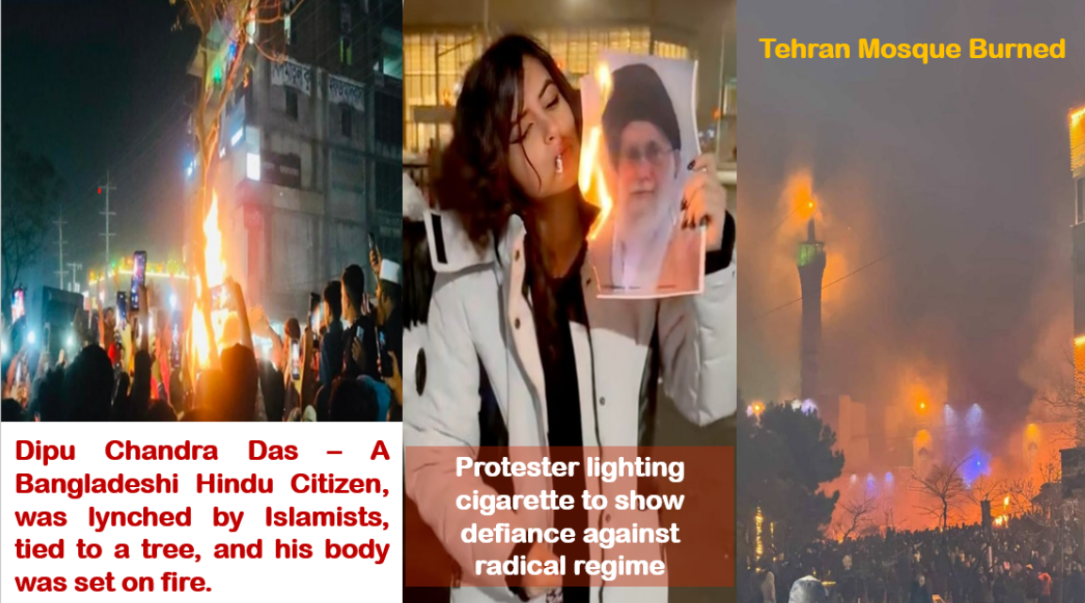
This article correlates Bangladesh’s surges of violence against Hindus with Iran’s societal backlash against state‑mandated Islam. In Bangladesh since late 2024, blasphemy rumors, mob vigilantism, and weak or politicized protection have produced lynchings, sexualized terror, and arson targeting Hindus. Rights groups and media chronologies show dozens of blasphemy‑linked assaults, while officials have dismissed critical assessments as “misinformation.” [Amnesty: Aug 2024; HRW/ASK reports; Dhaka Tribune/Govt statements]
In Iran, however, the UN Independent International Fact‑Finding Mission (FFMI) found crimes against humanity during and after the 2022–23 protests, concluded the state bears responsibility for Mahsa Amini’s death, and documented escalating hijab enforcement and surveillance against women and girls. [UN OHCHR press release, Mar 14, 2025; AP/VOA coverage]
In both cases, religion is instrumentalized by power, and too often, authorities participate, tolerate, or deny abuse, intensifying harm.
I. Bangladesh: Anti‑Hindu Violence and State Implication
1) What the violence looks like on the ground (2024–2026)
Durga Puja 2021 and after Aug 2024: Bangladesh has a record of anti‑Hindu attacks; during the October 2021 Durga Puja violence, mobs vandalized temples, prompting paramilitary deployment and hundreds of arrests. Human Rights Watch urged protection and accountability. [HRW, Oct 21, 2021] Following Prime Minister Hasina’s ouster in August 2024, Amnesty urged the interim government to protect Hindu and other minority communities as incidents of vandalism and intimidation resurfaced. [Amnesty, Aug 14, 2024]
Late‑2025 / early‑2026 cluster of Hindu‑targeted attacks:
Lynching of Dipu Chandra Das (Bhaluka, Mymensingh) – Dec 18, 2025. A Hindu garment worker was beaten, hanged from a tree, and set ablaze after rumors of “insulting religion.” Police and RAB made arrests; officials later said no evidence supported the alleged blasphemy post, and reporting described how colleagues forced him out amid workplace tensions before the mob attack. [NDTV/Hindustan Times/The Indian Express; bdnews24]
Rape of Dipu’s sister: Widely circulated social posts alleged the rape of Dipu’s sister, which could not make in mainstream reporting.
Amrit Mondal (Rajbari, Pangsha) – Dec 24, 2025. Another Hindu man was beaten to death; police framed it as tied to alleged extortion, but commentators highlighted a pattern of vigilantism in the same fortnight. [Firstpost]
Khokon Chandra Das (Shariatpur) – Dec 31, 2025 / Jan 1, 2026. A Hindu shopkeeper was hacked and set on fire while returning home; he jumped into a pond but later succumbed to his injuries; investigations were opened. [Times Now/News18]
Sexualized terror and public humiliation (Kaliganj, Jhenaidah) – Jan 5, 2026:
A 40‑year‑old Hindu widow was raped: Two men (Shahin, Hasan) who broke in her house, raped her, tied her to a tree, cut her hair, recorded the assault, and demanded money. A medical exam indicated abuse, and the police recorded her statement.
Reports note a property dispute/harassment backdrop, linking sexual violence to coercive control over assets. [NDTV/Firstpost/ABP Live]
Arson targeting Hindu homes (late‑December 2025):
Pirojpur (Dumritola, Saha family) – Dec 27–28, 2025. Several rooms/houses were torched at dawn; some accounts say doors were locked from outside, forcing escape by cutting through tin/bamboo; police later confirmed five arrests. [NDTV/News18]
Near Chattogram (Raozan) – late Dec 2025. A similar dawn arson set Hindu homes ablaze; families reported being trapped and escaping by cutting through tin; police made arrests. [News18]
Earlier 2025 incidents:
ASK condemned mob vandalism and looting of Hindu homes in Rangpur’s Betgari Union after loudspeaker incitement. [The Business Standard/ASK]
Matua Hindu homes were torched in Abhaynagar (Jashore) after a local dispute. [Borderlens report]
Blasphemy as an accelerant: HRCBM documented 71–73 blasphemy‑linked attacks across 30+ districts in June–Dec 2025 (arrests, beatings, vandalism of homes/temples, expulsions, and deaths), often triggered by disputed/fabricated/hacked posts and escalating into collective punishment of Hindu localities. [HRCBM report; India Today/NDTV summaries]
2) State implication and institutional failures (Bangladesh)
Direct and tacit involvement, then denial: Rights trackers and local media chronologies show recurring anti‑Hindu attacks and institutional failures to prevent or prosecute, while the interim government publicly dismissed outside assessments as “misinformation.” This denial hampers accountability and emboldens perpetrators. [Dhaka Tribune/Govt statements; Religion Unplugged]
CSA misuse & absence of rapid digital forensics: Authorities frequently invoke the Cyber Security Act against alleged “religious insult,” but rarely deploy rapid verification before mobs mobilize; in Dipu’s case, investigators later said no proof existed, illustrating policy gaps that risk mob justice. [FBI-style note is not applicable; use bdnews24/NDTV]
Slow or uneven protection: ASK documented delayed and inadequate responses, even when suspects were already detained, loudspeakers incited attacks on Hindu homes; lack of fast‑track communal‑violence prosecution fosters impunity. [ASK statement; The Business Standard]
Sexual violence and property coercion: Kaliganj shows sexualized terror used to dominate Hindu women and control property; survivors face barriers to timely justice. [NDTV/Firstpost]
Structural dispossession (Vested Property Act): Decades of state‑enabled expropriation of Hindu lands (Enemy Property Act → VPA)-1.6–2.6 million acres-left enduring inequities; contemporary attacks often intersect property control, with weak enforcement against encroachers. [Insight UK report; academic paper]
II. Iran: Secularization Under Theocracy and State Implication
1) A documented secular shift
Large‑sample GAMAAN surveys (2020–2023) show rising support for secular governance and identity signaling (e.g., “Survey Zoroastrianism”); a leaked 2024 government study reportedly found ≈73% favor secular government and widespread perceptions of declining religiosity. [GAMAAN; Iran International]
2) Hijab enforcement and emblematic cases
Jina (Mahsa) Amini – Sept 16, 2022: Arrested for “improper hijab,” died in custody; the UN FFMI concluded the state bears responsibility for physical violence causing her death. [VOA/AP; UN FFMI]
Nika Shakarami – Sept 20, 2022: BBC Eye (2024) cited a leaked IRGC document indicating sexual assault and fatal beating; the judiciary rejected the report, illustrating entrenched denial and opacity. [Jerusalem Post/Times of Israel; VOA rebuttal]
Sarina Esmailzadeh – Sept 23, 2022: 16‑year‑old beaten on the head with batons and died; IHRNGO verified and condemned pressure on the family to repeat a suicide narrative. [IHRNGO; Article19]
Hadis Najafi – Sept 21, 2022: 22‑year‑old shot during protests; media reports attribute the killing to security forces; authorities offered contradictory claims. [BBC; Zamaneh/JPost]
Armita Geravand – Oct 1–28, 2023: Collapsed while unveiled on a Tehran metro train and later died; activists allege assault; state claims fainting; no in‑car CCTV released and arrests at funeral reported (e.g., Nasrin Sotoudeh). [NBC/AP; BBC Farsi]
3) State implication and institutional failures (Iran)
Crimes against humanity & responsibility for Amini’s death: The UN FFMI found widespread violations, including murder, imprisonment, torture, rape, and concluded the state bears responsibility for Amini’s death and a systematic crackdown on women and girls. [UN OHCHR press release; UN News]
The “Noor plan” & surveillance: Since April 2024, authorities escalated hijab enforcement with drones, facial recognition, and state‑sponsored vigilantism, expanding criminalization of unveiled women and human‑rights defenders. [UN News; UPI]
Evidence suppression & denial: Repeated non‑release of critical CCTV, coerced confessions, and judicial harassment of families and activists at funerals reflect impunity and institutional obstruction. [BBC; VOA Persian]
III. Correlation: How Policy Failure and State Denial Make Violence Likely
Politicized religion + weak institutions + denial = violence. In Bangladesh, failure to verify blasphemy rumors, deter mobs, and protect Hindus during volatility, combined with official dismissal of critical assessments, has turned digital claims into collective punishment: lynchings, arson, and sexualized terror. [HRCBM; Dhaka Tribune] In Iran, coercive hijab enforcement and vague penal provisions, coupled with surveillance, denial, and intimidation, have intensified secular backlash and rights violations documented as crimes against humanity. [UN OHCHR; UN News]
Identity insecurity & property control: Bangladesh’s VPA legacy and current encroachments (e.g., cremation grounds) reveal how law and practice have facilitated material dispossession of Hindus; the Kaliganj rape shows sexual violence intertwined with property coercion. [Insight UK; HRCB] Iran’s turn to pre‑Islamic symbols often reflects cultural dissent under a theocratic state rather than mass conversion. [GAMAAN; academic analyses]
Digital ecosystems as accelerators: Bangladesh’s mosque loudspeakers and social media rumor cascades sparked attacks even when suspects were in custody; Iran’s digital sphere has documented abuses, prompting the state to expand electronic surveillance. [The Business Standard/ASK; UPI/UN News]
IV. Recommendations Tied to Identified Policy Failures
Capital punishment, where intentional killing and direct, imminent incitement are proven to Rabat and ICCPR standards-no broader. [https://southasianpolicyinitiative.org/], [ohchr.org]
Automatic LWOP (or maximum indeterminate terms) for organizers, funders, and remote instigators when intent to provoke lethal violence is proven but capital eligibility is not, plus asset seizure and victim compensation. (Tough, certain, and executable at scale.) (General deterrence evidence favors certainty over sentence severity.) [jstor.org]
No-impunity chain: command responsibility for officials; fast-track courts; robust witness protection; public dashboards of timelines. [ghrd.org]
Rumor-triage and platform MOUs to kill false “blasphemy” narratives within hours, reducing the chance of a lynch-trigger. Use EU monitoring and Christchurch Call protocols. [muse.jhu.edu], [dhakatribune.com]
Survivor services + property enforcement: Fund sexual‑violence survivor care (privacy, trauma treatment), enforce property rights in VPA hotspots, and provide relocation/legal aid where needed. [NDTV; Insight UK]
Bottom Line
Bangladesh’s anti-Hindu violence and Iran’s secular backlash are not isolated identity or policy disputes but state-implicated crises marked by denial and weak accountability. In Iran, investigations by the United Nations Office of the High Commissioner for Human Rights concluded that crimes against humanity occurred and that the state bears responsibility for Mahsa Amini’s unlawful death, finding that the government has rejected while obstructing accountability. In Bangladesh, rights groups and independent media have documented repeated attacks on Hindus alongside institutional failures—slow police response, poor prosecutions, and political dismissal of critical reports as “misinformation.” In both cases, official denial and tolerance allow violence and repression to persist.
A related, quieter pattern is visible in parts of Europe, where Christmas celebrations and public Christian observances have been cancelled or curtailed due to security fears or political pressure. While not comparable to mass violence, these decisions reflect the same structural risk because of Islamic hatred and intolerance: when states retreat from protecting lawful religious expression instead of deterring intimidation, they normalize coercion. The global lesson is that reforms alone are insufficient; without transparency and accountability for state actors, religion becomes a tool of power, and durable social peace remains out of reach.
Sources:
Bangladesh incidents & trend lines:
HRW on 2021 Durga Puja violence (https://www.hrw.org/news/2021/10/21/bangladesh-deadly-attacks-hindu-festival)
Amnesty statement (Aug 2024) (https://www.amnesty.org/en/latest/news/2024/08/bangladesh-interim-government-must-take-immediate-actions-to-protect-hindu-and-other-minority-communities/)
ASK condemnation (https://www.tbsnews.net/bangladesh/clear-violation-human-rights-ask-condemns-attacks-hindu-community-1199761)
Reports on Dipu Das, Amrit Mondal, Khokon Das (e.g., NDTV/HT/Firstpost/Times Now/India Today); Kaliganj rape (NDTV/Firstpost/ABP Live); Arson in Pirojpur/Chattogram (NDTV/News18)
HRCBM blasphemy-linked attacks (https://www.hrcbm.org/wp-new/blasphemy-as-a-license-to-kill-mob-lynching-and-burning-as-communal-execution-and-the-erasure-of-minorities-in-bangladesh/)
Structural dispossession: Insight UK report (https://insightuk.org/wp-content/uploads/2025/09/Report-Persecution-of-Hindus-in-Bangladesh.pdf)
Academic analyses of the VPA (https://rjwave.org/jaafr/papers/JAAFR2512425.pdf)
Iran secularization & cases:
GAMAAN surveys (https://gamaan.org/wp-content/uploads/2020/09/GAMAAN-Iran-Religion-Survey-2020-English.pdf)
Iran International (https://www.iranintl.com/en/202402245769)
UN FFMI press releases (https://www.ohchr.org/en/press-releases/2025/03/iran-government-continues-systematic-repression-and-escalates-surveillance)
AP/NBC/VOA on Armita; Amnesty/UN on Amini; BBC Eye & VoA on Nika; IHRNGO on Sarina; BBC/Zamaneh/JPost on Hadis.
About the Author
Brajesh Shandilya writes with the intent to document and interpret events unfolding across the world, drawing attention to patterns of injustice, silence, and accountability. Through careful observation and analysis, his work seeks to raise public awareness and appeal to conscience, encouraging informed reflection and a collective commitment to what is just and humane.
Disclaimer: The views and opinions expressed here are those of the author and do not necessarily reflect the official policy or position of Voice of Hindus. Any content provided by our contributors or authors is their opinion.
